General Discussion
Related: Editorials & Other Articles, Issue Forums, Alliance Forums, Region Forums
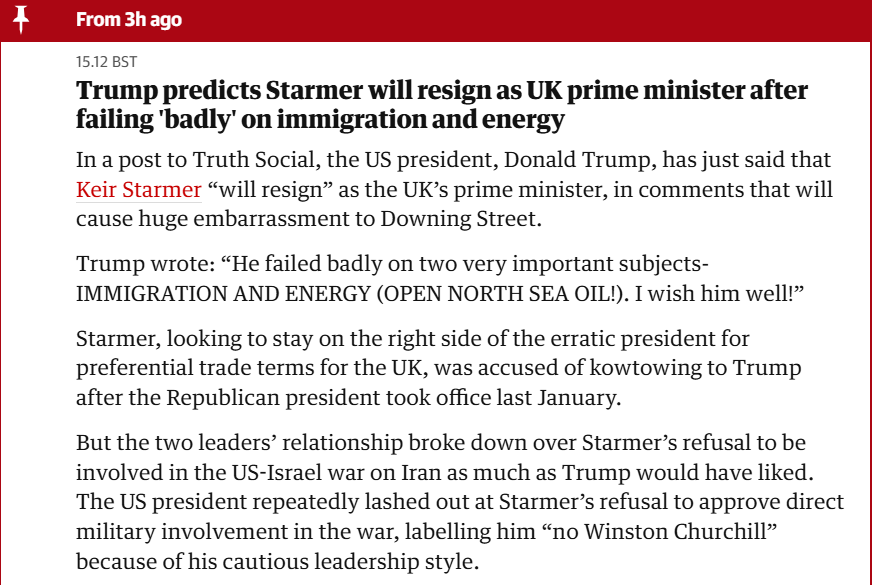
Starmer expected to announce departure on Monday as growing numbers of MPs back Burnham for PM
PM said to be reflecting on ‘political realities’, as president Trump joins in criticism of his leadership saying he has ‘failed badly’https://www.theguardian.com/politics/live/2026/jun/21/keir-starmer-expected-resign-resignation-monday--andy-burnham-makerfield-labour-uk-politics-latest-news-updates

 = new reply since forum marked as read
Highlight:
NoneDon't highlight anything
5 newestHighlight 5 most recent replies
= new reply since forum marked as read
Highlight:
NoneDon't highlight anything
5 newestHighlight 5 most recent replies

Ocelot II
(131,752 posts)A parliamentary system where some of the executive and legislative functions of government are merged makes that kind of change possible; unfortunately ours doesn't. There are flaws in parliamentary systems as well, but they make it possible to form coalitions among multiple parties as well as remove unsatisfactory leaders. I wish we could do that.

moondust
(21,373 posts)so I don't know what the complaints are against Starmer. UK having so many PMs in the last few years makes me wonder if they've lost all their patience for government.
Is Hedda Lettuce still available? 
muriel_volestrangler
(106,800 posts)eg https://www.democraticunderground.com/100221319244
" they've lost all their patience for government" may not be far off the mark - you'll also find articles on the web along the lines of "is the UK ungovernable?" We really don't have much money. GDP per capita, in constant US $, only exceeded the 2007 level in 2024: https://data.worldbank.org/indicator/NY.GDP.PCAP.CD?locations=GB
And that means that any government that would like to spend more on something (health, or, now, defence), or cut taxes, basically can't. So it's hard to see anyone becoming generally popular in government. Though Starmer has made several bad moves. The best chance for the UK is large scale tactical voting to elect "anyone but the Tories or Reform" (and if we're lucky, the even further right "Restore" party will take some of the Reform vote, without getting popular enough anywhere, give or take Rupert Lowe's current constituency, to win any seats). Unfortunately, a significant part of the UK electorate hates formal pre-election pacts, so it's very rare for parties to form them. That leaves it up to individual voters, or unofficial organisations, to work out how to get the "basically an OK person" parties efficiently competing in the seats they could win if united.