Welcome to DU!
The truly grassroots left-of-center political community where regular people, not algorithms, drive the discussions and set the standards.
Join the community:
Create a free account
Support DU (and get rid of ads!):
Become a Star Member
Latest Breaking News
Editorials & Other Articles
General Discussion
The DU Lounge
All Forums
Issue Forums
Culture Forums
Alliance Forums
Region Forums
Support Forums
Help & Search

The synthetic self

In order to better understand our human nature, we must attempt to build a robot capable of robust subjective experiences
https://aeon.co/essays/why-the-best-way-to-understand-the-self-is-to-build-a-robot-one

The iCub robot pictured at the Italian Institute of Technology in Genoa on 27 April 2022. Photo by Marco Bertorello/AFP/Getty Images
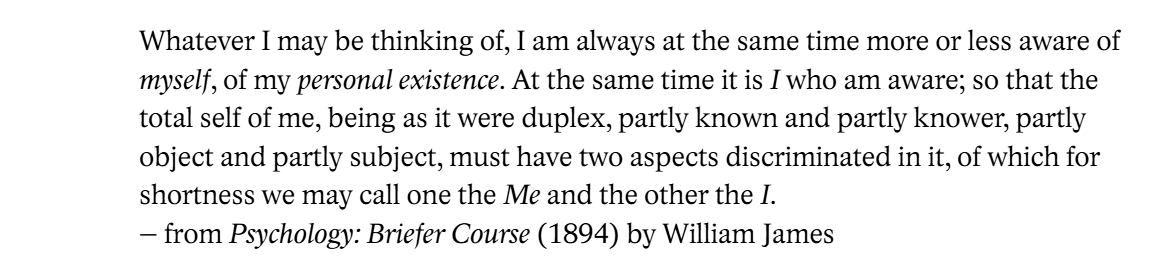
What is the self? The human condition is defined by our awareness that we are distinct from the world, that we are, in some way, the same person from day to day, even though our bodies change, and that the people around us are also selves. But we still do not really know what we are. As William James explained more than a century ago, the dual nature of the self lies at the heart of the mystery – the self is this most unusual thing, in that it is both the perceiver of itself and the content of what it perceives. Right now, for instance, ‘I’ can sense ‘my’ fingers as they type. I can also see a screen on which my words appear, and, if I choose, I can focus instead on the rims of my glasses, which move as my head moves. Interestingly, ‘my’ can refer not just to body parts but to things I wear, think or do. Although the skin is an important boundary between self and not-self, the self is more than just the physical body – it is also a set of ideas about who and what I am.
With the advent of generative artificial intelligence (genAI) that can converse fluidly in the first person, people are asking whether such AIs might someday have a sense of self. Indeed, might they have one already? (OpenAI’s GPT-5, perhaps reassuringly, says it does not.) This question is hard to answer for several reasons, but particularly because we still lack a good understanding of the human self. Significant progress is being made, however, through philosophical, psychological and neuroscientific investigations, and most recently by an approach that I and others have been exploring – the attempt to create or synthesise a sense of self in robots.
Based on what we have learned, I believe a foundational aspect of the human self is that we have physical bodies, and that our experience emerges from a fundamental distinction between what is, and what is not, a part of the ‘embodied’ me. If this is true, then a disembodied AI could never have a sense of self similar to our own. However, for robots that inhabit our physical world through a body – even one quite different to our own – the bets may be off.
To understand the motivation for building synthetic selves, we first need to explore how philosophers and scientists have sought to interrogate the human self’s nature. One part of the puzzle is that I feel as though there is a centre of experience, somewhere in my head and behind my eyes. Although it is tempting to see this as the seat of the ‘I’, this turns out to be an unhelpful idea since, as the philosopher Daniel Dennett points out in Consciousness Explained (1991), this invites an infinite regress of inner perceivers. Indeed, contemporary philosophers and neuroscientists are largely in agreement that there is no localised, unchanging, inner ‘I’ somewhere inside my head. This doesn’t mean we should abandon the idea of selves as unscientific or treat the self simply as an illusion or a purely social construct. Instead, we should find a better explanation.
snip
3 replies
 = new reply since forum marked as read
Highlight:
NoneDon't highlight anything
5 newestHighlight 5 most recent replies
= new reply since forum marked as read
Highlight:
NoneDon't highlight anything
5 newestHighlight 5 most recent replies
= new reply since forum marked as read
Highlight:
NoneDon't highlight anything
5 newestHighlight 5 most recent replies
The synthetic self (Original Post)
Celerity
Monday
OP

highplainsdem
(60,145 posts)1. No, we must NOT. We must try to get people suffering from AI addiction and AI psychosis to step back from the chatbot.
Sigh.
an approach that I and others have been exploring – the attempt to create or synthesise a sense of self in robots
All they'll end up with is the fake "self" already seen with chatbots.
SheltieLover
(76,945 posts)2. Absoloutely!

FalloutShelter
(14,199 posts)3. We must stop trying to humanize
That which is, by definition, inhuman.
It applies to robots and also applies to psychopaths.