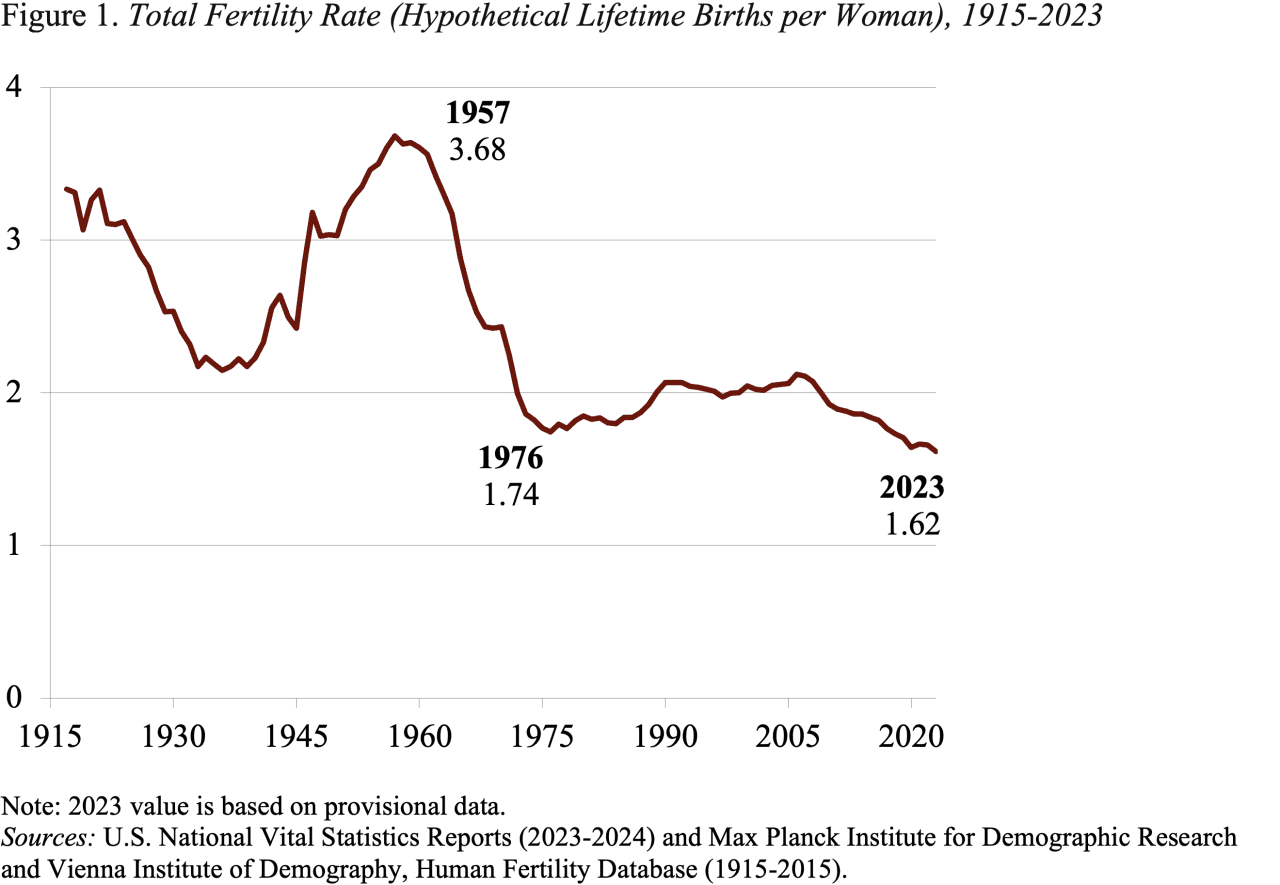
(and still continues to be) "angst" about "not enough" contributing to Social Security when you have "baby busts" periods.
WaPo just had an editorial about this a little over 6 months ago -
Opinion
Megan McArdle
Women are having fewer babies. That’s bad news for retirees.
May 14, 2024
The release of the annual Social Security trustees’ report is usually the occasion for some dolorous lament that we have inched another year closer to disaster. This year, however, I have good news! The industrious actuaries at the Social Security Administration, having ground through all the data, now think our nation’s looming entitlement meltdown looks slightly less catastrophic than it did last year.
They now forecast that the combined Social Security Trust Funds won’t be exhausted until 2035, a year later than they expected in 2023. They also see some improvement in the program’s long-term finances, primarily because of more favorable assumptions about productivity growth and disability rates — though that happy news is, they write, “partially offset by a decrease in the assumed long-term total fertility rate,” which has now gone from 2 children per woman to 1.9.
There’s only one wee fly in this optimistic ointment: This positive news depends on the fertility assumptions being correct, and they’re probably not. They’re probably still much too high.
The report’s authors have helpfully provided a guide to their underlying demographic assumptions, including a chart illustrating the evolution of fertility for women in various age groups. It shows that birthrates have fallen sharply for women in their 20s, plateaued for women in their early 30s, and risen significantly for women in their late 30s and early 40s.
(snip)
The report linked in the above from SS is here (PDF) -
https://www.ssa.gov/oact/TR/2024/2024_Long-Range_Demographic_Assumptions.pdf
And from here -
https://www.marketwatch.com/story/the-u-s-fertility-rate-is-falling-is-there-anything-we-can-do-78d7bc83

 = new reply since forum marked as read