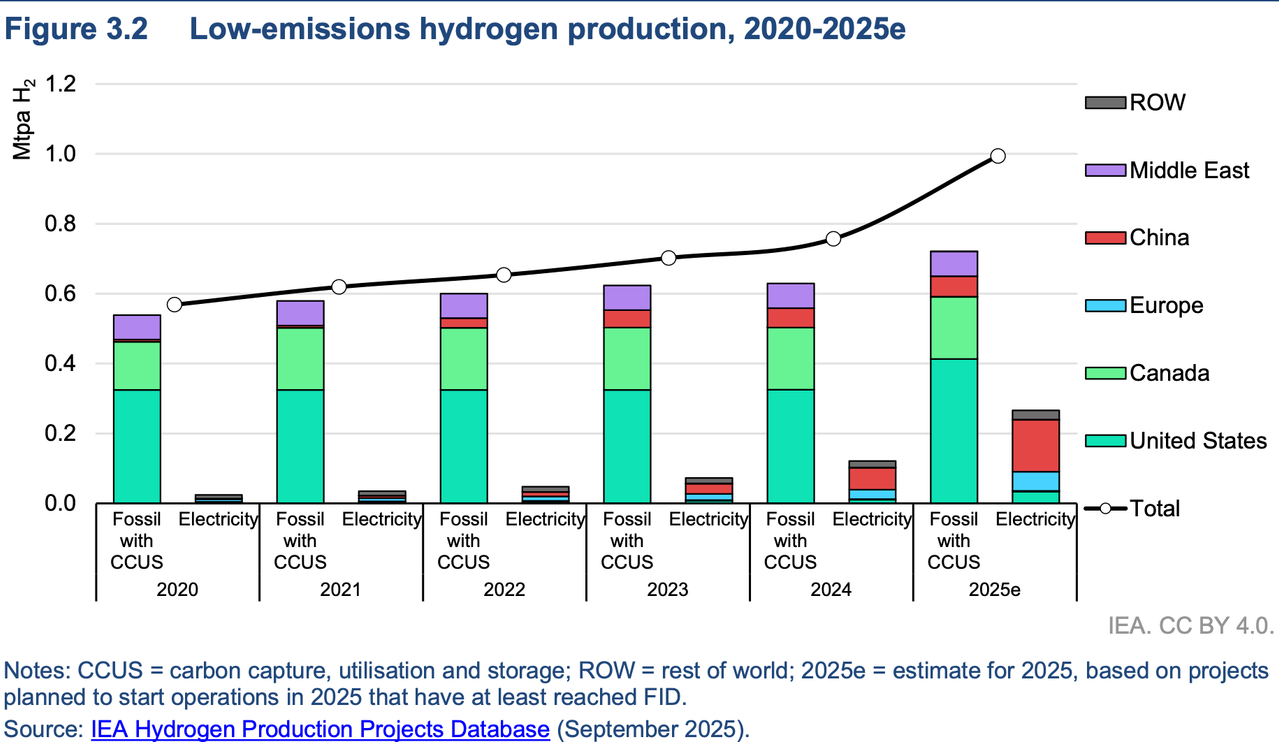
Production of low-emissions hydrogen" is increasing, albeit slowly:

IEA (2025), Global Hydrogen Review 2025, IEA, Paris https://www.iea.org/reports/global-hydrogen-review-2025, Licence: CC BY 4.0
Nuclear power, while (relatively) clean (compared to fossil fuels) cannot do all things. It can be used to produce hydrogen, which has many uses.
https://www.iaea.org/topics/non-electric-applications/nuclear-hydrogen-production
Nuclear hydrogen production
The hydrogen economy is getting higher visibility and stronger political support in several parts of the world. In recent years the scope of the International Atomic Energy Agency (IAEA) program on non-electric applications of nuclear energy has been widened to include other more promising applications such as nuclear hydrogen production and high temperature process heat applications. Nuclear hydrogen production technologies have great potential and advantages over other sources that might be considered for a growing the hydrogen share in a future world energy economy. The selection of hydrogen technologies (to be coupled to nuclear power reactors) greatly depends on the type of the nuclear power plant itself. Some hydrogen production technologies, such as conventional electrolysis, require only electric power. Whereas others, such as thermochemical cycles, may require only process heat (which may be delivered at elevated temperature values) or hybrid technologies such as the high temperature steam electrolysis (HTSE) and hybrid thermochemical cycles, which require both heat and electricity.